Competitor content describes Peppol as "the network that sends your invoice to the government." Half true — and the half that's wrong is exactly the part that decides whether you're compliant.
Here is what actually happens to an invoice in the UAE system, where the FTA sits, and how to check a provider is on the official register.
The five-corner model, in one pass
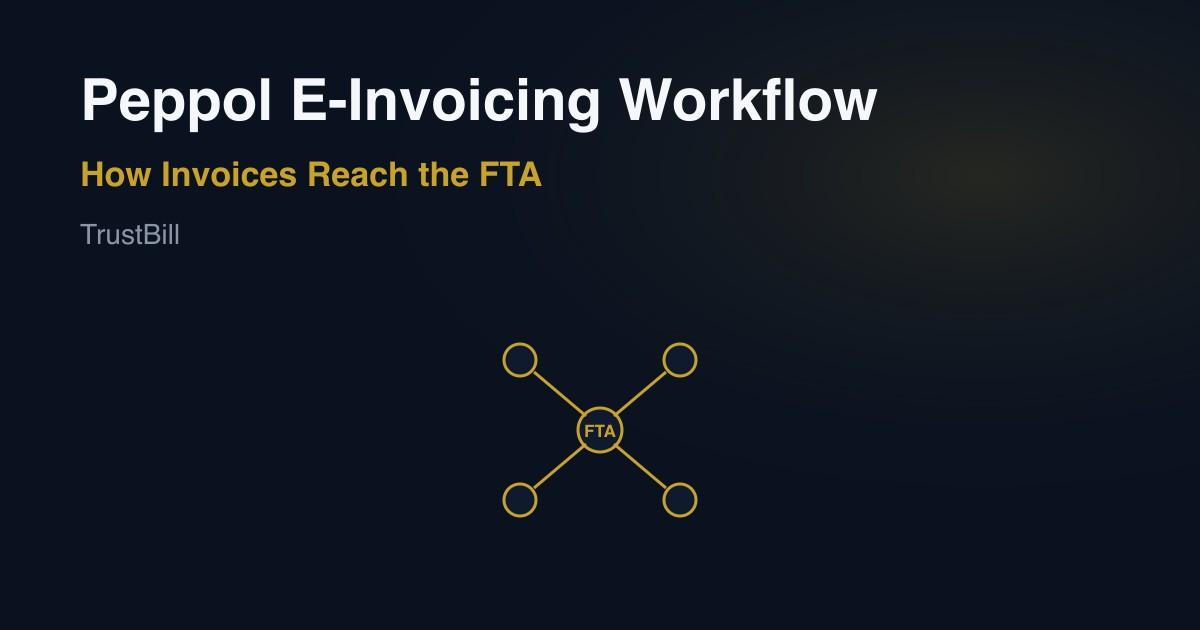
The UAE runs a decentralised continuous transaction control (DCTC) design — commonly called the five-corner model. Five participants, and the important detail is where the tax authority sits:
- The seller (corner 1) creates the invoice in whatever system it uses — ERP, accounting software, or a platform like TrustBill.
- The seller's ASP (corner 2) converts it to PINT-AE — the UAE-specific Peppol BIS format with TRN validation and bilingual support — and pushes it onto the Peppol network.
- The buyer's ASP (corner 3) receives it off the network, validates it, and delivers it to the buyer's system.
- The buyer (corner 4) gets a valid, machine-readable tax invoice.
- The FTA (corner 5) receives the invoice data through the accredited provider layer — not from you, and not by sitting in the middle of delivery.
The subtlety that matters: the FTA is not a relay in the delivery path. The seller-to-buyer document flow and the tax-visibility flow both run through the accredited ASPs. That's why the architecture is called five corners rather than four-plus-reporting — the state's visibility is designed into the exchange, not bolted on.
If you want the format-level detail — what PINT-AE adds on top of Peppol BIS Billing 3.0 — that's in our Peppol vs PINT-AE breakdown. This post is about the plumbing: the full UAE e-invoicing guide covers the mandate context around it.
What "on the FTA register" means
The Ministry of Finance maintains the official register of e-invoicing service providers — first as 41 pre-approved providers, progressing to full accreditation as each completes certification. Being on the register means the provider operates a real Peppol Access Point for PINT-AE and can carry compliant traffic.
This is the single most important check in vendor selection, because every claim of "FTA approved" bottoms out at the register:
- Not on the register → your invoices don't travel the compliant path. The software may generate beautiful invoices that never reach the FTA.
- On the register → the provider can legally operate the corner-2/corner-3 role.
We maintain a working directory at accredited ASP partners, and our verification guide walks through the four checks to run on any vendor — including confirming their legal entity name on the register, not just their brand.
Why the workflow shape matters for your choice
Once you see the model, three decisions get easier:
- "E-invoicing ready" software isn't compliance. A generator that produces XML but isn't connected to an accredited ASP only covers corner 1. The invoice never enters the network.
- Standalone ASP vs bundled platform. Enterprises can contract an accredited ASP and connect their own ERP to it directly. SMEs usually want the bundled route — software and submission in one. TrustBill submits through Microvista Technologies, an FTA-accredited provider, so the corner-2 connection is included in the plan.
- Free-zone and multi-entity structures follow the same flow. Licence jurisdiction doesn't change the corners — see the free-zone e-invoicing page for the entity-level detail.
The takeaway
Peppol is the transport, PINT-AE is the language, ASPs are the couriers, and the FTA reads through the couriers rather than intercepting the parcel. Your only obligation is picking a courier that's actually on the register — the rest is plumbing you never touch.